
When growers talk fertility, the conversation often starts with the big three — nitrogen, phosphorus and potassium. That focus is beginning to shift. AGRIntelligence data shows macronutrients are largely optimized across the US, leaving micronutrients as a frequent reason yields stall short of their ceiling. As growers start to think about nutritional planning for 2026, AGRIntelligence data can pinpoint when deficiencies show up and which nutrients deserve more attention than they’ve historically received.
At Commodity Classic 2026 in San Antonio, Derek Emerine, Helena National Agronomist, was joined by Jason Gregory, Helena Products Group Nutritional Brand Manager, and Brad Hammes, HPG Product Specialist based in Iowa, to discuss what AGRIntelligence tissue trends are showing — and what that means for prioritizing key nutrients and application timing in the season ahead. AGRIntelligence’s Extractor® tissue sampling tool is valuable in learning what is truly going on in the plant. In 2024 alone, about 24,000 Extractor tissue samples were analyzed on corn across the U.S., with about 13,000 coming from the Midwest market. For soybeans, Helena analyzed about 20,000 tissue samples, including about 6,500 from the Midwest.
That kind of volume matters because it allows agronomists to see not just single-field anomalies but repeatable trends by crop stage and geography — and those trends are shaping how Helena is advising growers to prepare for 2026.
When Emerine digs into that dataset, he sees a trend that matters for high-yield management: Many growers are already doing a strong job with the foundational macronutrients. “Our guys are pretty good at managing nitrogen, phosphorus and potassium,” Emerine says — but the tissue results increasingly point to micronutrients as the category showing up deficient more often. In other words, the next yield gains may not come from “more N-P-K” but from removing the smaller limitations that cap efficiency when everything else is already well managed.
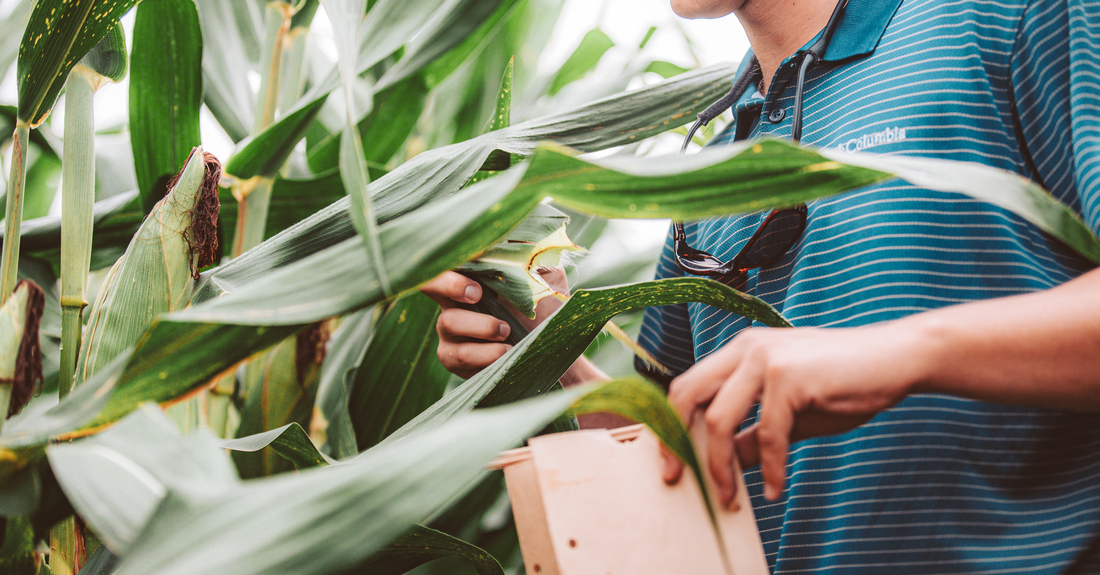
“We’re seeing these micronutrients show up more and more as being deficient."
Derek Emerine, National Agronomist for Helena
While crops require consistent nutrition from emergence to maturity, the timing of nutrient availability can significantly influence performance. As nitrogen programs have become more consistent, insights from Helena’s AGRIntelligence data point to micronutrients as an area where timing and execution continue to influence fertility program performance. Boron stands out as a strong example, supporting pollen tube formation and development along with fertilization during reproductive development. Growers must ensure micronutrients aren’t limiting the plant’s ability to capitalize on the investments they have already made.
Hammes says that not only is boron tied to the seed set, but it also is a key player in nitrogen assimilation. When boron is short, the plant will not be able to use nitrogen as efficiently. This can negatively impact one of the biggest investments in corn production, reducing the return on investment.
“If you don’t have all of the other nutrients you need to be able to use nitrogen, then it will be less efficient, and this may impact other nutrients as well."
Brad Hammes, HPG Product Specialist
Surprisingly, boron deficiency isn’t where growers typically expect it. Many growers tend to apply boron with the last herbicide pass, but data suggests there is hardly any boron deficiency at the V5–V7 stage. This is most likely a result of many growers applying boron at V5–V7. However, this doesn’t necessarily mean that boron applications should be a “one-and-done” application. Data shows boron deficiencies increase later: “As we get to about V11 and V14, it starts to jump up,” Emerine says. Gregory says that growers are buying plant nutrition, and elite genetics perform best when nutrition matches demand. Like an athlete, performance changes when a plan is built around what the body (or crop) truly needs.
Helena is working to fill the gap in boron delivery and timing. Pairing boron with controlled-release nitrogen technology can help avoid a “spike-and-crash” pattern and instead “spoon-feed a little boron” through key stages, with products such as Metra® Full Bor®launched in 2024.
“The data tells us we need to feed it at this point,” says Gregory.
As yield levels rise, nutrient demand can shift — what limits one field may not limit the next. Heading into nutritional planning for 2026 isn’t reinventing fertility; it’s refining it with better timing and better intelligence. AGRIntelligence tissue trends suggest many growers have the macronutrient foundation in a solid place, but micronutrients, especially boron, can become the quiet yield limiter as corn approaches reproduction. In a season where every field writes its own story, the data-driven, field-by-field approach may be the difference between protecting yield potential — and leaving a few bushels behind.
Connect with your local Helena representative to develop a data-driven nutritional plan for 2026.